Expertise
About us
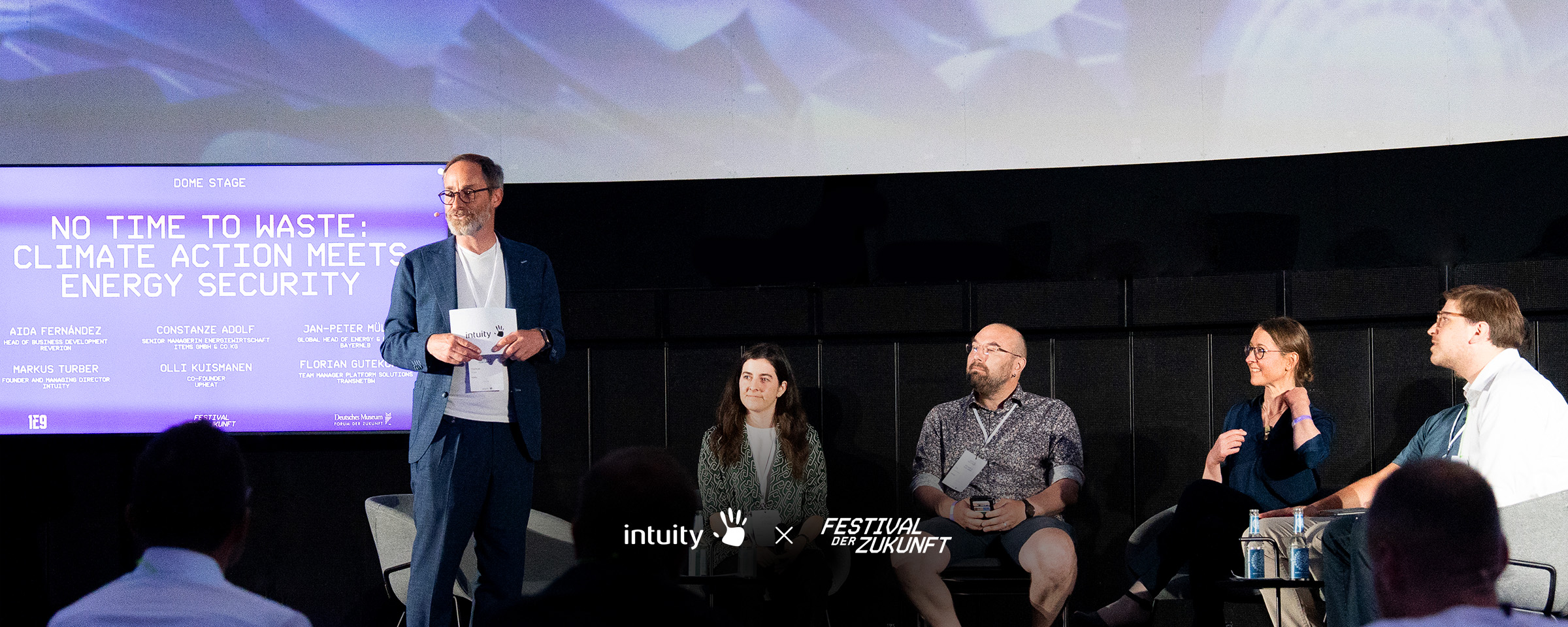
Energy Panel at the Festival der Zukunft
To shed light on the topic from different perspectives, we invited five experts from the fields of technology, finance, infrastructure and regulation to participate in our panel. They shared their perspectives and emphasized that there is a lot to do here, but also reason for optimism. Below the recording, we provide a brief overview of the most important talking points.
The transformation is underway, but it needs more speed
Technologies for a flexible, grid-friendly energy supply have existed for a long time. However, their widespread use often fails due to financing structures, regulatory hurdles or a lack of incentives and proactive players. Aida Fernandez, co-founder of Reverion, presented a technology that inspires at all levels: Flex power plants based on biogas and hydrogen offer the rare combination of renewable, controllable and grid-stabilizing energy generation, and could thus close a crucial gap in today’s energy system. They can be used decentrally and are economically scalable. They open up new ways to secure supply without fossil reserve capacities.
We need to stop looking for the perfect, risk-free technology and make possible what has long been a solution.
The technical status quo is not sufficient
Climate neutrality is not a sprint, but an endless endurance run. It requires a level-headed view of the potential to be leveraged through technical innovation. With pragmatic confidence, Olli Kuismanen, from Upheat, unlocks such potential with a simple question: How can it be that so much energy in the form of heat escapes the system unused? Upheat develops high-temperature heat pumps that bring industrial waste heat back into the system – efficiently, economically and directly applicable. But hardware is more than just a means to an end: it defines the limits of what is possible, forces us to find specific solutions, and shapes how we think about energy, supply and responsibility.
In an age of abstract concepts, physical technology often makes change tangible and real.

Political clarity instead of structural deadlock
Transformation is not a purely technological process – it is a social undertaking. And that means it has to be wanted, negotiated and shaped. Dr. Constanze Adolf, a strategist at items with a deep insight into EU policy and sustainable finance, highlighted the extent to which regulatory complexity and political inertia can slow down progress. If political systems and funding logics do not provide a clear direction, or even act contradictorily, tried and tested solutions lose their effectiveness. Instead of technological innovation, the result is often frustration. Clarity, commitment and participation are no minor side effects, but a fundamental prerequisite for real change.
Anyone who wants transformation must create conditions in which society can support it.
Investments need positive experiences
No transformation without capital – it's that simple. Jan-Peter Mueller, Managing Director for Energy & Mobility at BayernLB, drew attention to the interplay between economic attractiveness and political will. Positive experiences and reliable signals are needed for investments in renewable energies to materialize. If major projects fail or political intervention makes investment unattractive, it creates uncertainty that quickly spreads to the entire system. However, Jan-Peter struck a noticeably confident tone: There is enormous momentum in the energy transition for him. He is convinced we have the necessary technologies, know-how, and political support if we provide targeted incentives and take the right risks.
If you want to strengthen trust, you have to enable design, not just regulate.
Who bears the risk?
This question is particularly urgent in the energy system. Florian Gutekunst, Programme Manager at TransnetBW, works on coordinating decentralized energy sources, storage facilities and grids in a way that security of supply is guaranteed – even in times of structural transformation. However, in a system traditionally designed for maximum stability, the question arises with every innovation: Who takes responsibility if something goes wrong? Florian clarified that the transformation cannot succeed if infrastructure players rely solely on risk protection or push innovation onto others. We need a new understanding of shared risk, spread across more shoulders, embedded in political clarity and digital systems that make complexity manageable.
Diversity in the system reduces risks, but only if it can be managed and supported.

Energy as a social objective
The panel concluded with a call for action: the transformation will only succeed if society is involved and not presented with accomplished facts.
The momentum is there, but it is vulnerable. Now, it is a matter of preserving it, using it wisely, and involving everyone. Technology alone will not be enough. It needs communication, trust, and far-reaching reorganization.
Thanks to the speakers who took part in the great panel:
- Aida Fernández-Salazar, Reverion
- Olli Kuismanen, Upheat
- Florian Gutekunst, TransnetBW
- Dr. Constanze Adolf, Items
- Jan-Peter Müller, BayernLB
Our founder, Markus Turber, moderated the panel.
A big thank you also goes to 1E9 and the Deutsches Museum, who once again proved their commitment to the Festival der Zukunft: Visions need spaces. And change needs a stage.
Food for thought
- European emissions trading (Book, german) by Dr. Constanze Adolf and Marcel Linnemann
- Transformation is achieved through companies (Video, german) by Jan-Peter Müller